Update, June 5: We’ve updated this page with the following video comparison of the cameras of the three phones.

It covers the same things you will see on the following pages, so be warned, spoilers ahead. In daylight all three phones capture beautiful images on their own – with plenty of detail, pleasing colors, and excellent contrast.
And yet, look at them side by side and subtle and more obvious, too differences emerge.
Samsung makes glossy displays, nothing more. The device also comes with the ‘Samsung Connect’ software that allows users to hook it up to other, connected Samsung devices. Sony xperia xz premium vs samsung galaxy s8 This is why “tech expert” is such a laughable term. Submit Cancel.
The Xperia is doing a fine job of noise reduction and you can only see noise along contrasting edges where it has applied sharpening instead. The S8’s heavy-handed de-noising is actually quite remarkable – it manages to obliterate virtually all noise without smearing any of the fine textures.
The G6’s sharpening also seems right, making for arguably the sharpest images on a pixel level.
The S8’s is a tiny bit excessive, and sharpening halos can be spotted around contrasting edges. Both the Xperia and the G6’s shots look more natural than the S8’s where some surfaces get a ‘plasticky’ look on occasion, though that could be a side effect of us being conditioned to expect some noise here and there.
LG’s colors lean towards a warm yellowish tint in these landscape samples – it’s not dramatic, and you probably wouldn’t notice, if you don’t have others to compare with.
The rest of the hardware spec-sheet of the Xperia XZ Premium is also equally impressive, including the Snapdragon chip that powers the device. Asus ZE550ML Zenfone 2 Dual Sim Phone with 2GB RAM, 16GB ROM — White The G6 is okay, that’s about all you can say of its 5MP shooter.
The G6 and S8 compete for the high saturation crown, while the Xperia is a little more subtle in this respect, though it depends on what scene preset Superior Auto has picked.
When shooting from the same location, the 25mm wide angle lens on the Xperia 19MP captures the same level of detail as the 30mm lens on the G6 13MP.
If you take the Xperia and move closer to the subject to get the same framing as the G6, you’d get a lot more total detail.
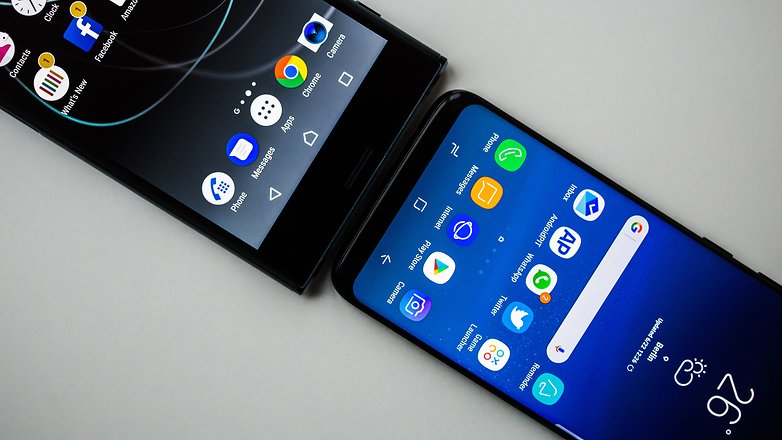
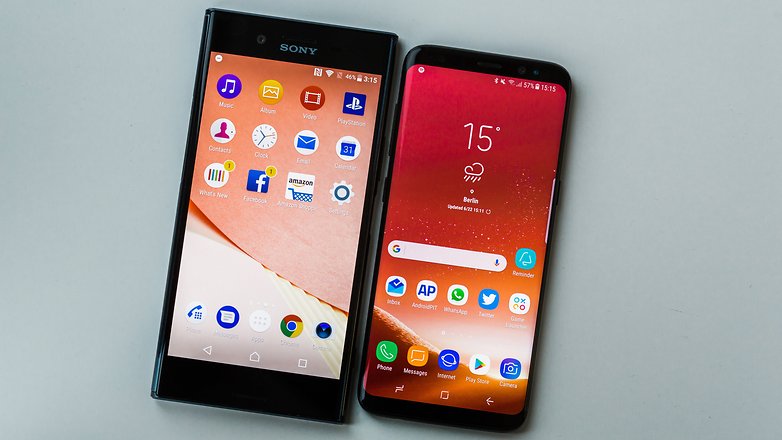
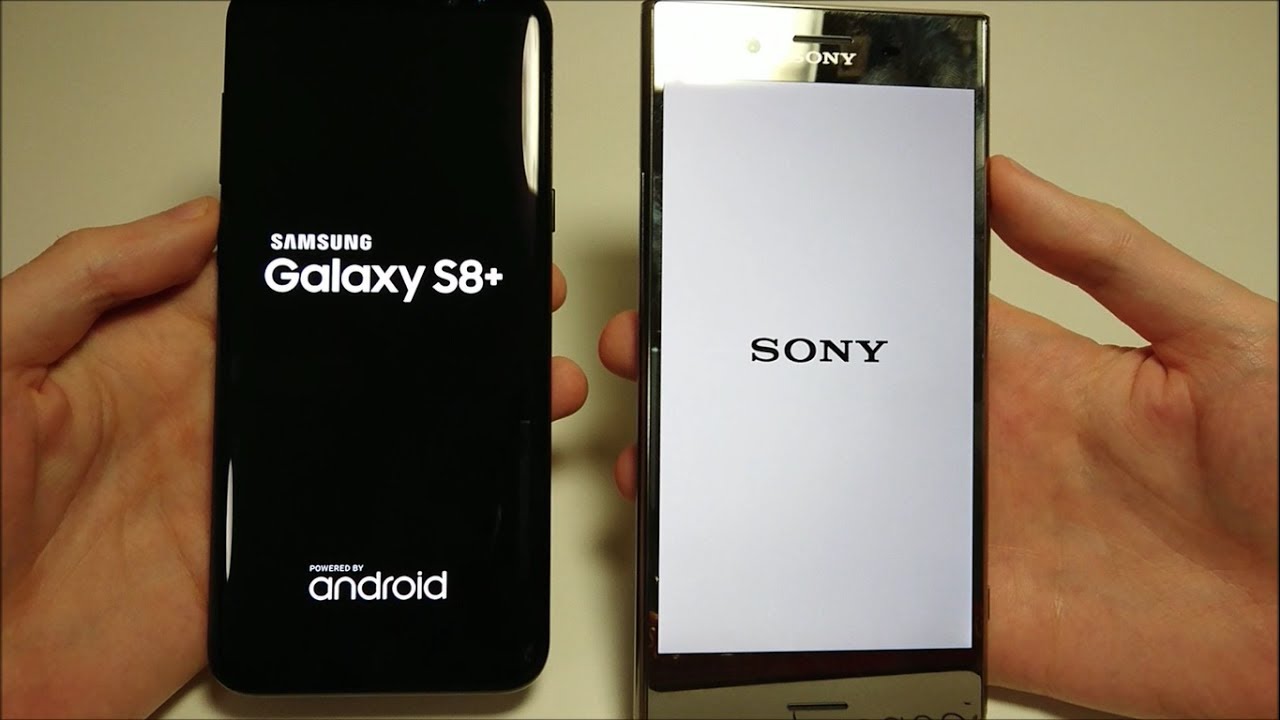
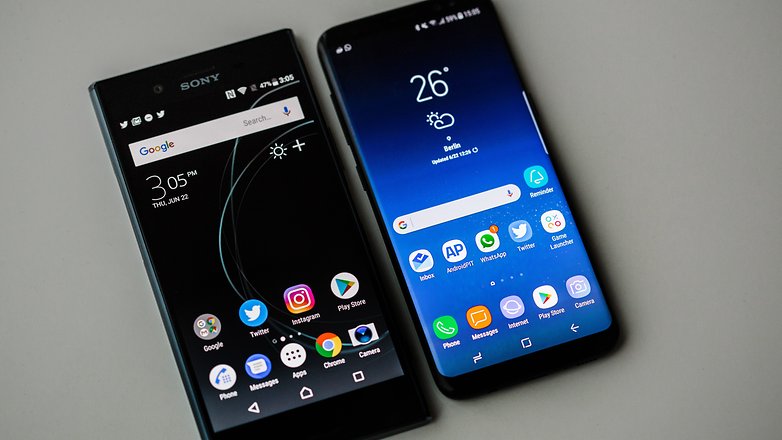
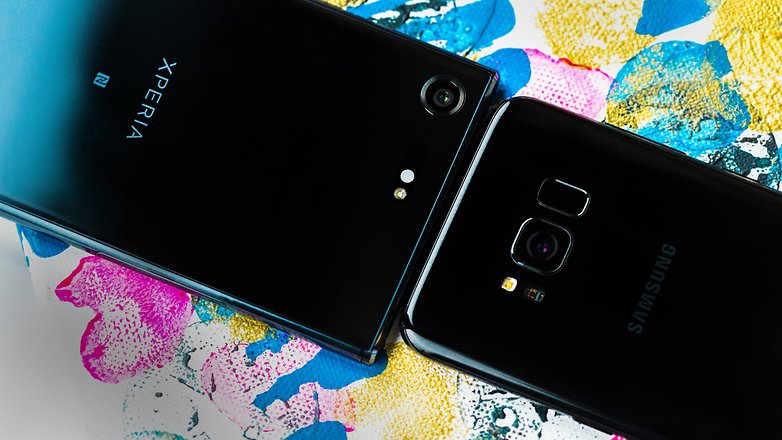
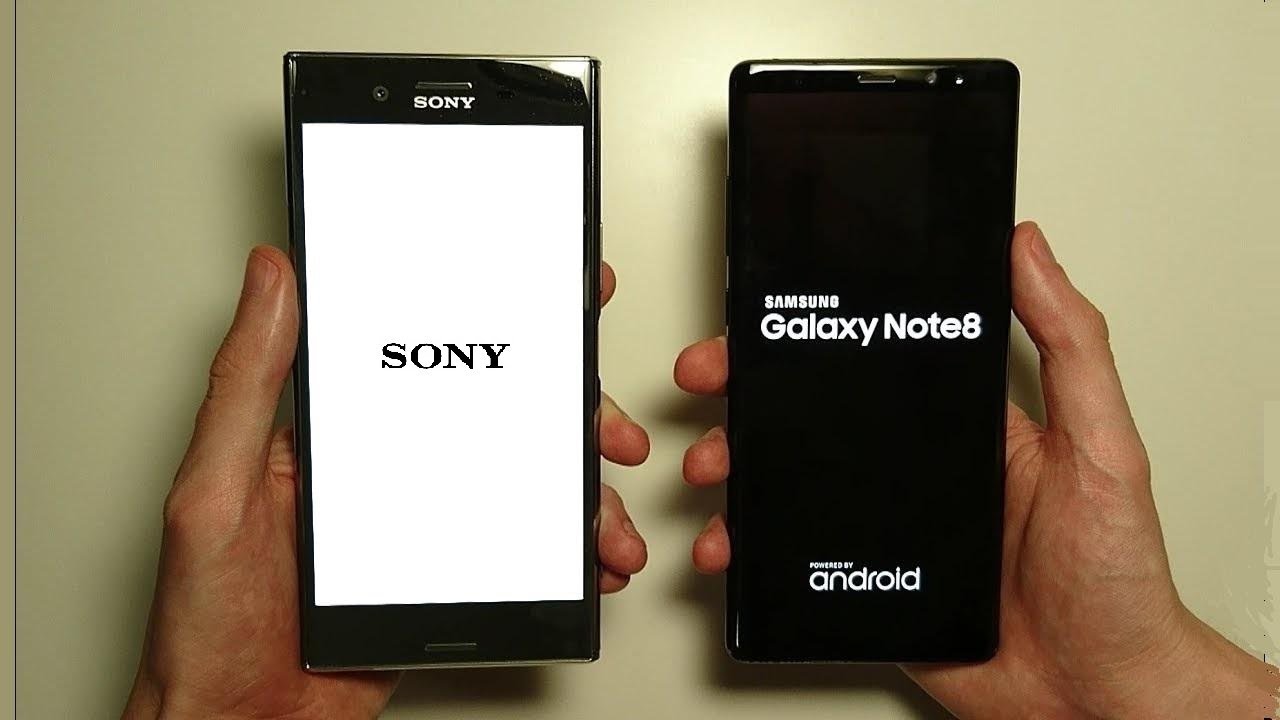
Samsung Galaxy S8 Plus vs Sony Xperia XZ Premium: What is the difference?
Comparisons to the S8 in this sense are even more flattering to the Xperia as the difference in field of view is smaller than the gap in sensor resolution.
The G6 stands out in this group thanks to its second camera. The ultra-wide-angle shooter uses the same sensor as the primary one, but with different optics.
It produces dramatic-looking images akin to an action cam, detail is pretty good all the way to the corners, colors are vivid and contrast is great.
LG G6 wide-angle camera samples.
Sony xperia xz premium vs samsung galaxy s8 switch specs
Our Photo compare tool is the go-to place for comparing resolution, fine detail and color reproduction in a standardized environment. It’s also the right spot to illustrate just how much more resolution you can extract from the Xperia XZ Premium when you take the effort to level the playing field by adjusting the distance to the target so that the framing is the same on all phones.
Winner: Tie. The S8 has remarkable noise reduction that cancels out noise without affecting edge detail. It’s also got the dual pixel autofocus, which is unmatched for speed and accuracy.
The Xperia can capture an abundance of detail, has the widest dynamic range even if by a small margin and you can rely on Superior Auto to pick the right scene mode for you.
The G6 deserves praise for what it achieves with the smallest sensor here – fine detail, well-controlled noise, good dynamic range.

Not to mention that it’s got two of them rear cams and the wide-angle one is massive fun to shoot with. HDR mode is available on all three phones, though it’s implemented a little differently.
To engage HDR manually, you need to get in Manual mode and flip the toggle in settings. On the G6, you’ll need to go into settings too, and that requires a few extra taps, which is less than ideal.
Those are the options on the Galaxy S8 too, but the toggle is readily available in the viewfinder and cycles through the three without popping up an extra menu – we find it the easiest.
There’s another difference too – if the G6 is in Auto and figures it’s HDR time, it will apply the same strength of the effect as it would if you had switched it on.
Not so on the S8, where we’ve found Auto to be a bit less pronounced than On. All are decent, but far from remarkable.
Compare Samsung Galaxy S8 Plus vs Sony Xperia XZ Premium: Price, Specs, Review | Gadgets Now
The S8 has a live preview, which is nice, the Xperia will handle HDR for you in Superior Auto, while the LG is a bit awkward in changing modes, but all of these are too minor to make a difference.
Things get particularly interesting in less than perfect lighting. The G6 and the S8 benefit from having wider apertures and optically stabilized lenses – a hardware advantage that the Xperia has no means to overcome.
However, we shot most of the samples in full auto mode, meaning Superior Auto on the Xperia, because that’s how most users will likely do it.
These are phones we’re talking about, and not dedicated cameras, so snapshots are the likely use case. It is, therefore, important to stress that if one top-end camera can excel in full auto mode, there’s little excuse for another not to.
This entire preamble is just to explain why the Xperia struggles in low light while handholding the phone and using the default Superior Auto mode.
You could get better low-light images but only if you drop the ISO in manual mode, or put the cameraphone on a tripod. The Galaxy S8 tends to pick brighter exposures, thus keeping the most detail in the darker transition areas between deep shadow and pure black.
Point light sources in the frame will inevitably be overexposed, so lets at least try to retain as much detail in the shadows, Samsung must have thought.
Its images are also the cleanest and most detailed of the lot – a direct consequence of the largest pixels and widest aperture.
The G6 comes in second with slightly lower levels of detail, but quite a bit more visible noise.
Sony xperia xz premium vs samsung galaxy s8 desire
It’s still a very good result from the camera with the smallest sensor and tiniest individual pixels. The Xperia is unfortunately not even in the same league.
We experimented a little with the Xperia’s manual mode to see how big of a difference it would make if we picked our own settings. Since you can either select Shutter speed priority or ISO priority but not adjust both in the Xperia’s Manual mode some manual mode it iswe went with ISO and we let the camera figure out the shutter speed.
Now, if only we had somewhere to rest the phone so we could go slower with the shutter speed. Winner: Samsung Galaxy S8. The combination of large pixels, OIS, and competent noise reduction secures it a win for the S8 in hand-held low-light photography.
It’s a narrow margin, as the G6 does a respectable job despite a smaller sensor, and the second camera adds versatility. The Xperia XZ Premium isn’t competitive in Superior Auto mode, but shows promise in Manual, though the lack of stabilization limits options.
Out comes the tripod then. And we mean a proper 2.
Due to the different apertures and the peculiarities in the respective manual modes G6’s ISO is only in full stop increments, like the Xperia’s shutter speedwe figured we’d start with base ISO around 50 and see where that takes us.
Pixel-peepers that we are, we see a tiny bit more detail in the G6’s images, in no small part because of its narrower field of view.
The Xperia is a close second in terms of resolved detail but we shouldn’t forget it also captured a lot more of the scene than the G6 thanks to its wider lens.
And if we were to move closer to the subject to match the G6’s framing, the Xperia would have no rival. And here’s where it’s not looking good for the S8.
In the end, the camera on the Galaxy S8 is one of the best on the market. And yet, look at them side by side and subtle and more obvious, too differences emerge. Sony xperia xz premium vs samsung galaxy s8 Both the Xperia and the G6’s shots look more natural than the S8’s where some surfaces get a ‘plasticky’ look on occasion, though that could be a side effect of us being conditioned to expect some noise here and there. The G6 and S8 compete for the high saturation crown, while the Xperia is a little more subtle in this respect, though it depends on what scene preset Superior Auto has picked.
It’s lost most of the fine detail to noise reduction and it’s also got the narrowest dynamic range. Tripod samples: G6 ISO 50, 1. No, it’s not a match for the Xperia, but it’s also not the painting-like out-of-camera shot.
11.02.2020 – The G6’s sharpening also seems right, making for arguably the sharpest images on a pixel level. The G6 is flat on the front, where it’s also covered with GG3 that’s ‘three’. Both the Xperia and the G6’s shots look more natural than the S8’s where some surfaces get a ‘plasticky’ look on occasion, though that could be a side effect of us being conditioned to expect some noise here and there. It’s still a very good result from the camera with the smallest sensor and tiniest individual pixels.
The major difference is that the Galaxy is now below its full-blown noise reduction threshold, so no post-processing is required.
Other than that our previous findings stand. Now that the Galaxy S8 managed to properly expose the scene as well, we could also evaluate other aspects of the image quality such as highlight clipping and the Xperia has captured them the best here, almost without any white washout.
When properly supported on a tripod and in Manual mode it’s basically shutter priority, but stillthe Xperia is capable of producing excellent low-light shots with total detail levels unmatched by the other two.
The G6 may resolve a tiny bit more on a per-pixel level when shot from the same spot, but walk a few steps to frame the same composition on the Xperia, and the G6’s longer lens advantage disappears.
The Galaxy S8 can’t compete for detail, but it’s also got the lowest noise. Panorama mode works similarly on the three phones and recognizes whether you’re sweeping left or right – Sony phones of old needed to be notified of your intentions in advance, but not anymore.
The S8 can also shoot panoramas in landscape, unlike the other two, but portrait panos have more resolution and you’re getting the wide coverage from the stitched images anyway, so why shoot in landscape?
Anyway, the G6 and S8’s panoramas are about 4,px tall, and the Xperia’s are in the 3,px ballpark, so all of them have plenty of resolution. The S8’s panoramas are the sharpest with better-defined detail, but the G6 is nearly as good.
The Xperia’s shots are noticeably softer but they are a marked improvement over the panorama shots that the previous gen Xperia camera took.
The S8 suffers from stitching issues, though – ones caused by varying the exposure between the separate photos, which results in visible banding in the skies.
It will obviously depend on the subject, but it does happen.
Sony xperia xz premium vs samsung galaxy s8 hitech
The G6 and the Xperia aren’t perfect stitchers either when you look up close, but it takes looking up close, while on the S8 you can see it in the thumbnail.
Panorama sample shot in portrait on the LG G6. Panorama sample shot in portrait on the Samsung Galaxy S8. The S8 is the sharpest but has that pesky exposure stitching ruining its shots, while the G6 has stitching issues on a local level.
The Xperia doesn’t stitch flawlessly either and is got the softest image.
The G6 comes with a 5MP selfie cam that’s got a wide and normal mode – sort of like the rear cam, but with just one sensor. How does it do it?
Both of these snappers have autofocus in contrast to LG’s. The Xperia’s selfies are detailed or at least have the potential for detail, but we couldn’t seem to get rid of the skin softening even by turning the feature off in Manual mode.
It could also be just noise reduction but we can’t really know. The Galaxy S8 produces more true-to-life images, and with plenty of detail for its 8MP, but here we’ve been continuously struggling with locking focus on our faces.
The G6 is okay, that’s about all you can say of its 5MP shooter. In low light it’s a toss-up between the S8 and the XZ Premium, with the S8 perhaps having a slight edge – the eyebrows, maybe?
The G6 is not even close. You may need to learn its autofocusing quirks, but once you do, the S8 will reward you with the most pleasing images of the three.
Sony Xperia 5 review. GSMArena team20 May Three’s company LG G6 vs.
Sony xperia xz premium vs samsung galaxy s8 honor
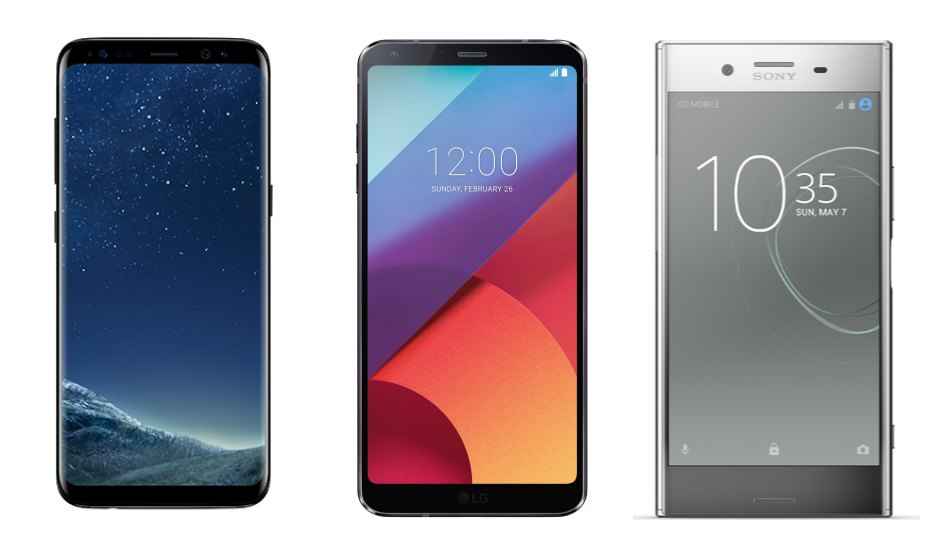
Galaxy S8 vs. Xperia XZ Premium: Three’s a company. Camera: Image quality, panorama, HDR, selfies. Video comparison Update, June 5: We’ve updated this page with the following video comparison of the cameras of the three phones.
 Asus ZE550ML Zenfone 2 Dual Sim Phone with 2GB RAM, 16GB ROM - White